‘We tell stories, we laugh, we eat’: Reflections from the Twinning Project
By Caz
The Twinning programme has created four pairings between an urban social justice organisation and a nearby rural Community Supported Agriculture (CSA) scheme. Running since 2024 and supported by the National Lottery Community Fund, the programme aims to build bridges between previously unconnected communities and centre social justice work in the agroecological movement.
CAE-Cae Tan twinning pair
James and Caz from the Real Farming Trust’s Food Justice team travelled to Swansea in April to visit the CAE-Cae Tan Twinning pair. The CAE is a charity that holistically supports migrants in Swansea city centre, especially towards economic independence and employability; Cae Tan is a CSA scheme a few miles away on the Gower Peninsula.
The Old Oak – twinning community film screening
In Swansea, the Twinning pairs gathered for a community film screening of the 2023 Ken Loach/Paul Laverty film, The Old Oak.
In the film, there’s a pivotal scene featuring a young woman, Yara, who has arrived in a mining village near Durham as a refugee. Yara looks at photographs in the abandoned back room of a pub where the landlord, Mr Ballantyne, has offered her some support. She sees photos of a community meal being served; in one photo is a banner reading “They Shall Not Starve”; another is captioned “When you eat together, you stick together”.
This caption touches Yara and she reads it out to Mr Ballantyne. He explains the phrase comes from his mum, and Yara replies that “we used to do the same in Syria – we used to cook together with our neighbours and sleep under the stairs in case we were bombed”. In turn, Mr Ballantyne explains the photo was taken during the 1984 Miner’s Strike, when he “had just started down the pit and the Government tried to starve us back to work”. Women Against Pit Closures and similar groups often organised community meals during the strike, and – in a different context – this is what goes on to happen in the film. Yara, Mr Ballantyne and other characters come together as a mixed audience of refugees and local residents to share meals, and to distribute food donated to those struggling to make ends meet.
Article continues below the video.
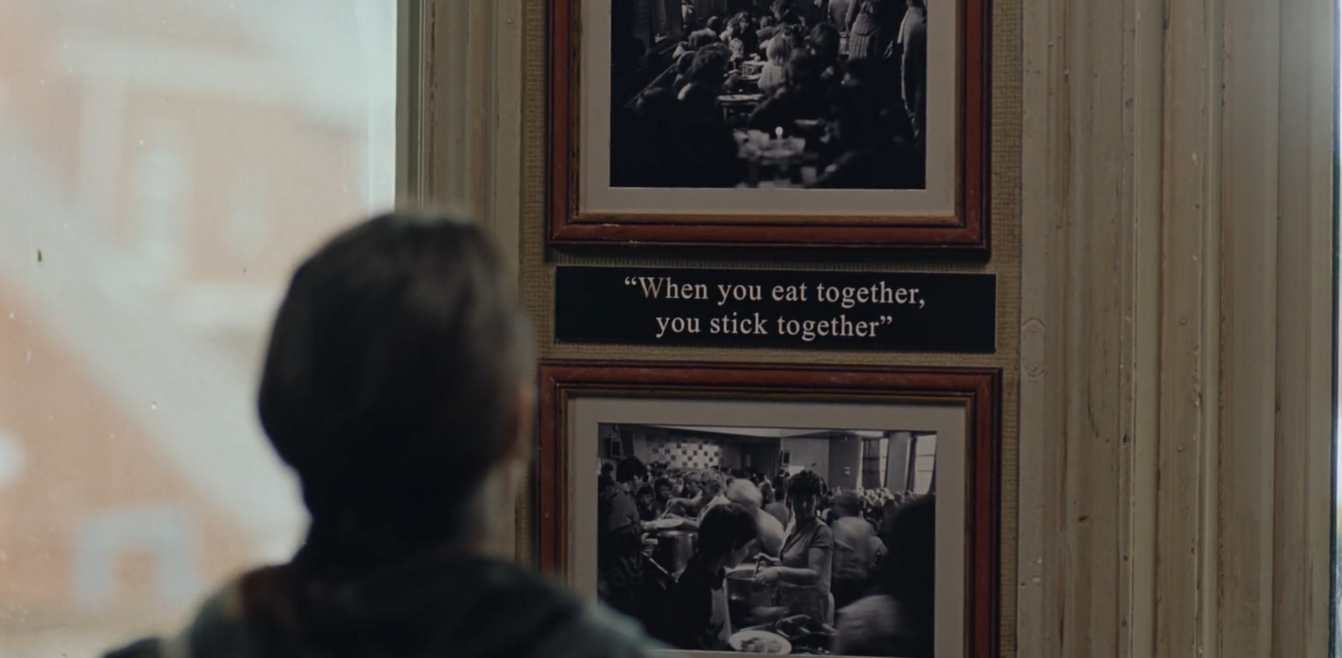
“When you eat together, you stick together”
The CAE-Cae Tan Twinning project, and the friendship between Mr Ballantyne and Yara in the Old Oak both bring communities together across individual differences and societal separation to provide opportunities to get to know one another. They specifically do this through food: whether growing, cooking or eating together. Through the Twinning project, the Real Farming Trust has been exploring food related settings as a tool to build these bridges between communities.
Caz caught up with Sansha, a Twinning participant and a volunteer with the CAE, to gain an understanding of the value of the film night and of the efforts to connect a migrant charity with an agroecological scheme for the communities involved.
Sansha discussed the universal worth of gathering around food and farming:
Getting together in a real setting [is different], physically, where you can cook together, laugh together, eat together, wash together, plant together. That was a real heartfelt experience for me and I was very grateful for that. You know, people we are just one human race from different cultures and skin colours… we are all the same.
This echoes the poignant quote picked out by Yara in the film: “when you eat together, you stick together”. Connections forged through gathering around food are simple, universal, and strong.
Connected communities, new horizons
When thinking back to previous Twinning activities where participants from the CAE visited Cae Tan and other growing spaces on the Gower, Sansha spoke about how much these visits broke the ice between communities. She fondly recounted tagging along with growers in order to understand tasks, and from there, getting to know someone new and ending up laughing together. The community Twinning days felt joyful and playful:
We tell stories, we laugh, we take a break, we eat, then we go around and we plant, we take pictures, we joke around..
Everybody’s together, we’re just giggling like little children coming together to play in the garden.
Connecting to the bigger political picture
Building these connections in communities that include migrants, refugees and asylum seekers takes on added significance when seen in their wider political contexts. Amid rising anti-immigrant narratives, the Twinning of a CSA on the Gower with a city-centre migrant support charity feels more important than ever.
Communities across the country are often isolated and there is growing polarisation, often between communities of people who do not have chances to meet and learn about each other’s lives, even when in close proximity. Prejudice and hatred can thrive in these environments, but the Twinning programme has been experimenting with what happens when we bring people together around food.
A facilitated discussion after the film guided attendees to see both the film and the Twinning project within this wider context. Community members from both Twinning partners shared the strong impression left by the racism witnessed in the film.
Sansha reflected:
That could have happened to any one of us because people just discriminate because they don’t understand…. before we can judge, why don’t you have a conversation?
By giving people new opportunities to know one another, the partnership between CAE and Cae Tan is creating less space for divisive politics to emerge in the communities they serve. Conversations over food can create bonds and familiarity that become a vehicle for combatting hostile attitudes and discrimination.
The future of the twinning model
As the Twinning programme moves into its final year, we at the Real Farming Trust are working to understand and share reflections on the longevity of the Twinning model in our partner communities and beyond. Sansha expressed hopes that the project can continue longer term to help touch more people’s lives through opportunities to learn about their neighbours and the land they live on.
We look forward to sharing more about the activities as they unfold over the year, and to sharing overall findings from the work – how the Twinning model could be helpful to other organisations in the agroecology or social justice worlds, and how the impacts of Twinning partnerships can be sustainable in their communities beyond the funding period.
Read more about the project’s work on our Twinning programme page.
Explore Food Justice resources
Webinar recording: Growing Inclusion in Your CSA
Webinar recording: People’s Assemblies