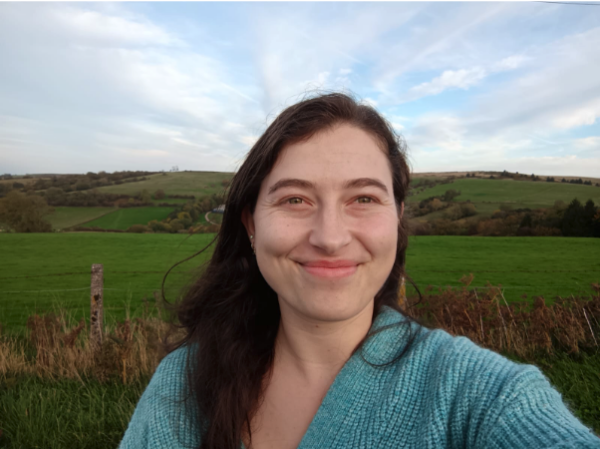
Meet the Practitioner: Ele of Fivepenny Farm
Fivepenny Farm is a 40 acre mixed agroecological farm in the South West of England on the Devon-Dorset border, right by the beautiful Jurassic Coast. They produce meat, juice, preserves among other seasonal products, and have communal processing facilities that are available for local farmers and community groups.
What does agroecology/nature-friendly farming mean to you within the context of your business or farm?
Agroecology means that we fully embrace all aspects of our food system and try to find a balance in activity that ensures all are considered and cared for, from the mud that clings on to our wellies but also to essential minerals, to the thistles that make for spiky hay bales but bountiful bees, to the people who leave open gates and accidentally weed up your freshly sprouted lettuce, who are noisy and hungry, who are so so eager to be involved with this joyful process of creating from and returning to the land. It is a continual process of experimentation and learning, seeing how to work together with each element to create a balance that works for us.
How did your agroecological journey begin? What inspired the shift toward this approach? Was there a turning point or specific challenge that motivated the change?
I am a second-generation agroecological farmer, inspired by my parents and our communities around the world to carry on the good work, both because I have experienced the changing world and the growing threats of climate change and biodiversity loss, but also the effect that it can have when people work to combat these threats. I remember visiting my matrilineal homelands in Kerala which suffered from extended drought and then severe floods, and I also remember seeing an agroecology school there create a grove of mixed trees and fruits and flowers that withstood it all. There are continual challenges, but seeing the beautiful ways that we adapt and overcome inspires continual motivation as well.
How do you put the principles of agroecology into action day to day? For example, in soil management, biodiversity, community engagement, or business operations.
One of the beautiful things about agroecology is that, once it gets going, it keeps going, taking a little bit of the burden off of farmers – and this is great, because farming can be really tough. My parents spent a long time restoring the soils from the chemically-degraded monoculture that we moved on to, and now the legumes and the cows and sheep keep a biodiverse, carbon-rich, flood-resilient pasture going with very little work from me, and it in turn creates healthy happy animals that very rarely need to see the vet. A decision to live with the weeds that crop up on field margins and between veg beds has saved my back, but also created a rich insect population that controls many crop pests, and has boosted our local bird and bat populations. We put the time saved into supporting the social and political aspects of agroecology, including hosting educational courses, incubating new entrants, and spreading the word. This is the aspect that builds a community, and which brings us joy (also the birds, the birds are great).
What are the main challenges you face? Where do you see the biggest policy gaps or opportunities?
For a while now, farmers have been essentially working in isolation, driven by a competitive mindset, to deliver ever-increasing demands. The benefits of support networks, and community connections, and good and willing new entrants, can do so much to reinvigorate us. I think small investments into promoting on-farm research, with support for developing peer-to-peer training and collaboration, would help to build these networks. Providing more funding to set-up community-facing businesses that provide public goods on a small local scale, such as CSAs, would help to promote public health and farm viability. And supporting and platforming organisations that already do so much to connect us and help make our voices heard, such as the Landworkers’ Alliance, will help all round!
Why do you believe agroecology is vital to the future of UK food and farming?
As a small island facing large threats, it is becoming more important than ever that we protect and regenerate our soils and natural capital, but also that we produce enough healthy food to feed our local communities in spite of shocks, and also that we educate and rebuild connections between communities and nature. Only by managing all of these can we ensure that our food and land use system is sustainable for the long term, and agroecology is the only solution that manages this balance.