Meet the Practitioner: Lee Robb of Carrick Greengrocers
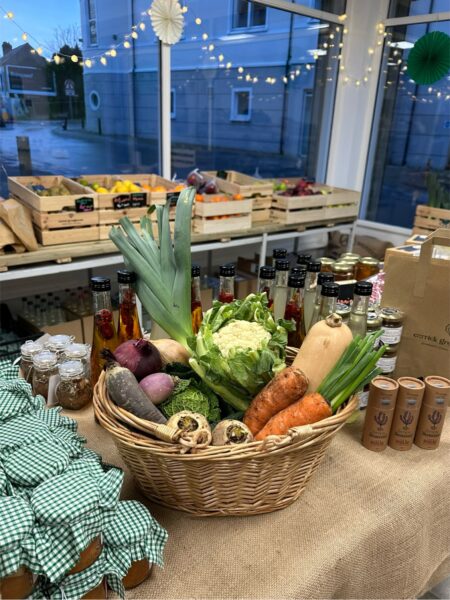
Lee Robb is one of the founding directors of Carrick Greengrocers. They are a community-owned cooperative in Carrickfergus, about 10 miles outside Belfast. They have been trading in our town centre for just over 2.5 years and want to increase access to great quality fruit and veg and demonstrate how community-owned businesses can play a vital role in the revitalisation of our places.
What does agroecology mean to you within the context of your business or farm?
As a greengrocer, we want to sell produce that is good for people and the planet – that supports good health and a good life for everyone, and nurtures our soil, biodiversity and local resources so they are replenished rather than depleted. This also extends to paying our suppliers and employees fairly and trying to build a sustainable business that treads lightly on the world by minimising food waste, trying to focus on local produce where possible and connecting with the wider agroecology movement in NI and the UK.
How did your agroecological journey begin? What inspired the shift toward this approach? Was there a turning point or specific challenge that motivated the change?
Carrick Greengrocers grew out of a project we ran at Positive Carrickfergus, a CIC that I founded in 2017, where we asked people what their wildest dream for Carrick was. Many people responded that they wanted to see more shops in our town centre.
At the same time, we were involved in a Sustainable Food Places project being delivered by Mid and East Antrim Borough Council, which started a conversation about where people shop for local produce. As we hadn’t had a greengrocer on our high street for at least 10 years, many people were leaving our town (population 30,000) to buy good quality local produce.
So we identified a gap in our town centre and a need from the community, and started talking to people about a community-owned greengrocer. There was a lot of energy for this idea and, as we developed it, we found a local grower practising agroecology who has become one of our key suppliers.
Our customers prize this local produce, grown using agroecological methods, brought to our shop on the day it is harvested and only travelling 3 miles. It tastes better, lasts for a long time in the fridge and there is a pride that it is grown in Carrick.
How do you put the principles of agroecology into action day to day? For example, in soil management, biodiversity, community engagement, or business operations.
Our shop is run by the community – currently we have 434 members in our cooperative who all invested in an idea, a proposal to create change in our town and how we access local produce. We have a voluntary board of directors who are nominated by our members, who are responsible for decision making and the day to day running of our shop. We have one part-time shop manager who works 3 days per week. The other 3 days our shop is run by volunteers including our directors and other members. We also have volunteers who are customers and work with local organisations who work with people with learning disabilities to give them work experience and an opportunity to connect with the wider community in the same way as people without learning disabilities. We are purposely cultivating a slow, community space where people feel welcome, where we know each other’s names, and have time for each other, as well as selling food.
We are always looking for opportunities to support our work with our community and the Bridging the Gap programme was a great opportunity to offer climate and nature friendly food at a 50% discount to people on low incomes for 18 months as part of our Friendly Food Club, and participate in a UK-wide project aiming to influence policy-makers. The programme allowed us to trial community meals, which we will continue this year along with our Friendly Food Club, which is now funded for our members.
What are the main challenges you face? Where do you see the biggest policy gaps or opportunities?
When it comes to agroecology our biggest challenge is that there are not enough growers in Northern Ireland using agroecological practices and there is little support to encourage growers to change their practices and land for new entrants who are interested in growing in this way. Many of our customers ask if all our produce is ‘organic’ and we have to explain to them that NI does not grow enough of that type of produce to fully supply our shop. So we know there is a demand that is not currently being met.
There is also the perception that agroecologically grown produce is more expensive. This is true in many cases but not all, and sometimes people are comparing apples with oranges, e.g our agroecologically grown salad bags are more expensive than the alternative from a supermarket but our bags can last for up to 2 weeks in the fridge. So we need to find ways to communicate the positive difference. And, in fact, when we price checked our agroecologically grown baby carrots last year, they were cheaper than Tesco’s conventionally grown baby carrots.
Given there are so few growers and they are operating at a small scale, there is a lack of infrastructure to support both growers and shops like ours and we lack negotiating power when compared with larger scale operators. Agroecological growers often struggle with routes to market so we would like to see a NI wide programme supporting local communities to open their own greengrocers, which would then start to build the infrastructure needed for lots of small scale growers and shops.
Finally we would like to see policymakers acknowledge the benefits of making agroecologically grown fruit and veg more accessible by offering support as detailed in Bridging the Gap report released in November 2025.
Why do you believe agroecology is vital to the future of UK food and farming?
More and more people are concerned about the chemicals used in conventional farming, the potential harm to people, and the real harm caused to nature with extremely worrying impacts on biodiversity and the depletion of our soils. On the other hand, the relatively big gains for nature that can occur in quite a short timeframe by practicing agroecology gives many of us hope that we can undo the harm we have caused in the last 30-40 years and find a better way to grow the food we need locally.
Our customers can meet our suppliers on our shop floor and talk to them about what they are growing and how they are growing it. Our suppliers are available and accountable to our local community in a way that many large scale producers are not. It is clear that we have not sufficiently prepared for the challenges that the climate emergency is bringing and even the recent cyber attack on M&S meant the vegetable shelves were empty for a number of days in Carrickfergus.
We need a food system that has robust actors at every level of the food system and those adopting agroecology and supporting the sale of agroecological products offer a practical solution to some of the challenges that exist in our food system and hope to people who feel powerless.